
The South African Civil Society Information Service
A nonprofit news agency promoting social justice. Seeking answers to the question:
How do we make democracy work for the poor?
A nonprofit news agency promoting social justice. Seeking answers to the question:
How do we make democracy work for the poor?


By Jean Triegaardt · 1 Aug 2008
The first decade of democratic dispensation in South Africa was hailed in many ways as an economic success. Macroeconomic stability was restored, the country’s debt level was reduced to internationally accepted norms, and the country attained an investment-grade credit rating. Growth was high in 2005, there were capital inflows and the rand was strong at that time. As a result of these achievements, economic growth and employment were finally beginning to increase, with observers, as recently as 2007, predicting that economic growth would average five percent during the remainder of the decade.
Yet, despite these economic gains, huge disparities remain in South African society. Although there is evidence to suggest that income inequality has narrowed somewhat over the last decade, South Africa’s income inequality remains one of the highest in the world according to the World Development Report of 2006.
In South Africa, poverty and unemployment are inextricably linked. According to Statistics South Africa, the number of unemployed individuals in 2005 was considered to be over 8 million persons if you subscribe to the expanded definition of unemployment. Overall, inequality is widening as a result of the unemployment crisis.
For the period 1996 to 2006, there has actually been a slight rise in inequality in South Africa as a whole (the Gini increased from 0.60 to 0.64). Within race groups, inequalities increased among black South Africans from 0.53 to 0.64; for coloureds from 0.48 to 0.56; for Indian South Africans from 0.47 to 0.50. The only race group where inequality has declined in post apartheid South Africa is for whites - for whites the Gini declined slightly from 0.45 to 0.44.
Of greatest concern is the fact that more than a decade after the demise of apartheid, the distribution of income in South Africa is more unequal than it has ever been, despite substantial budgetary redistribution in the form of social assistance.
The key factor driving unequal income distribution under apartheid was not systematic racial discrimination, but rather the ‘growth path’, that is, the path on which the economy grew over a period of time.
There are some economists who suggest that the trajectory of inequality was on the same growth path during the apartheid years, as in post-apartheid South Africa.
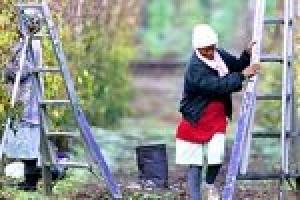
Our high levels of inequality in income distribution are the result of a growth path that ensured high earnings for the owners of capital and employees with skills. At the same time, it has limited the growth of employment, generating high unemployment, and restricting opportunities for smallholder agricultural production. In South Africa, agricultural land ownership still remains highly skewed with 87 percent of farming land being owned by whites and just one percent owned by blacks.
Racist considerations informed the growth path under apartheid, but after the termination of apartheid, the same pattern continued because deracialisation produced an implicit class coalition with a vested interest in the growth path.
Historically, the overall set of public policies that shaped ‘who gets what’ can be considered as the ‘distributional regime’. This is determined by labour market policies, redistribution through the budget (through taxation and social spending), and the path and pace of economic growth determine income distribution.
Deracialisation has not transformed the distributional regime that determines how public policy shapes income distribution in South Africa.
Research has demonstrated that extreme inequality can be detrimental to economic growth, social stability and development. When opportunities are accessible to people on any other basis other than merit, the resulting economic benefits to society can potentially be lower than they would otherwise be.
Stated differently, when individuals with potential to contribute to socio-economic development are excluded from taking part, society as a whole suffers. Inequality of opportunity in the credit, financial, goods, and labour markets can lead to underinvestment and through that lower economic growth and development.
A more equitable distribution of opportunity can, in principal, result in a higher level of income and economic development. During the last decade, there has been an increasing body of empirical evidence showing that societies in which opportunities are open to a wider range of people also tend to have a higher level of development (2006 World Development Report).
In examining the history of inequality, there are two aspects of South Africa that bear consideration: the persistence of extreme levels of inequality in the distribution of income; and the existence of poor people who lack access to land, employment and skills.
Just under half of South Africa’s 47 million people are poverty-stricken with African people being the worst of. According to the United Nations Development Programme, Africans form the majority of the poor, comprising 90% of the almost 22 million poor people in South Africa.
On the occasion of his 90th birthday, Nelson Mandela’s message was:
"There are many people in South Africa who are rich and who can share those riches with those not so fortunate who have not been able to conquer poverty. Poverty has gripped our people. If you are poor, you are not likely to live long."
Mandela had good reason to use the occasion of his birthday to raise concerns about redistribution because just as good tidings have entered his life, he is well aware that he is among the fortunate few to have flourished in the new South Africa while a large proportion of others have not, as wealth and opportunity remain concentrated in the hands of a few.
 Should you wish to republish this SACSIS article, please attribute the author and cite The South African Civil Society Information Service as its source.
All of SACSIS' originally produced articles, videos, podcasts and transcripts are licensed under a Creative Commons license. For more information about our Copyright Policy, please click here.
To receive an email notification when a new SACSIS article is published, please click here.
For regular and timely updates of new SACSIS articles, you can also follow us on Twitter @SACSIS_News and/or become a SACSIS fan on Facebook.
Posts by unregistered readers are moderated. Posts by registered readers are published immediately. Why wait? Register now or log in!
Wealth Distribution
I could not agree more. The economic distribution was skewed under Apartheid in two ways. Firstly, casting racial categorisation aside, it was skwed in terms of its unequal distribution to the population as a whole. Secondly the proportion of the population on the receiving end of the distribution for the most part was white although there were other racial groups involved too.
The trouble with the ANC government's policies is they have only sought to address the second, or racial, skewing and they have done closeto nothing about the first skewing which continues to until today and which is in fact a far greater long term socioeconomic problem than the racial skewing.
What we are in need of is Socioeconomic Democracy [SD]. It is fully described in
'Socioeconomic Democracy: an advanced socioeconomic system' by Robley E george ISBN: 0-275-97376-X. SD advocates a democratically set income floor below which no member of society is allowed to fall and a democratically set wealth ceiling which nobody is allowed to exceed as any excess is just taxed away.
Entitlement
Income Inequality is indeed a big challenge, but the poor cannot sit back and wait for the government to give them a hand out. This sense of entitlement has to change, and entrepreneurship, like shown by our foreigner refugee friends, must be promoted.
Poor Political and Business Leadership
The economy is in a mess. The world is in a mess. How did we get into such a mess? We have been led here by the nose which we refused to see past. Who led us here? Our leaders of course. Why did they lead us into such a mess? Because they want to be admired, praised, fawned on and to remain in the driver